How to Use Trading Confluences in 2026 to Filter Entries and Avoid Low-Quality Setups
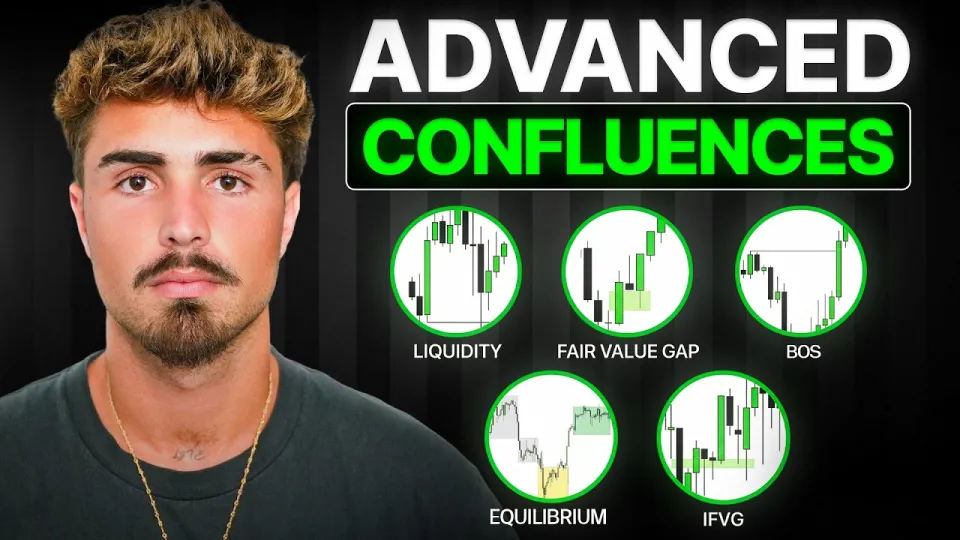
Video: Learn Every Trading Confluence In 18 Minutes
Need articles like this for your video? They help promote it on YouTube and Google — order them in the Telegram bot @sat_sit_bot. It writes articles around your video, embeds the video and publishes them on popular niche websites (no ads). Your first 50 articles are free.
· based on the channel TJR
Key takeaways
- Confluence means two or more independent signals agreeing on the same price area, not stacking indicators that measure the same thing.
- The core building blocks covered in TJR's 18-minute breakdown: liquidity, fair value gaps (FVG), inverse FVG, equal highs/lows and break of structure (BOS).
- A fair value gap is a three-candle imbalance; an inverse FVG is the same zone after price has traded through it and it flips role.
- More confluences is not automatically better: each added condition cuts the number of trades and can push you into curve-fitting.
- Risk per trade and a written journal matter more than any single setup, because most day traders lose money.
Trading with confluences means waiting for two or more independent signals to point at the same price area before you take a position, instead of acting on a single pattern. The most common building blocks are liquidity sweeps, fair value gaps, inverse fair value gaps, equal highs and lows, and break of structure. TJR's video "Learn Every Trading Confluence In 18 Minutes" walks through that toolkit in one sitting, and the same framework is what the free trader blueprint at the TJR blueprint page is built around.
What a trading confluence actually is and why one signal is not enough
A confluence is confirmation from a second, structurally different source that a level is worth trading. A single signal, such as a fair value gap sitting in the middle of nowhere, tells you almost nothing about whether price will react there; the same gap sitting behind a swept low and aligned with the higher-timeframe trend is a different proposition entirely.
The practical test is independence. Two moving averages crossing plus an oscillator reading are not confluences, because they all derive from the same price series and tend to agree mechanically. A liquidity sweep, a session high and a higher-timeframe order block are confluences, because each one comes from a separate observation about where orders sit.
A workable hierarchy looks like this:
- Direction from the higher timeframe (daily or 4-hour structure).
- A draw on liquidity: a prior high, prior low, equal highs or equal lows where stops are likely resting.
- A displacement move that leaves an imbalance behind.
- A return into that imbalance, ideally overlapping a structural level.
- A trigger on the lower timeframe with a defined invalidation point.
If a setup only satisfies step three, it is a fair value gap trade and nothing more. That is fine as a discretionary idea, but it should be sized as a lower-probability trade.
Liquidity, fair value gaps and inverse fair value gaps in practice
Liquidity refers to clusters of resting orders, usually above equal highs or below equal lows, that price is drawn toward because that is where stops and breakout entries sit. Traders mark these pools in advance and treat a sweep through them as a potential trap rather than a breakout.
A fair value gap is a three-candle imbalance: when a strong candle leaves a gap between the wick of the first candle and the wick of the third, price often returns to that zone before continuing. It is a footprint of aggressive, one-sided participation, not a guarantee of a reversal.
An inverse fair value gap is what a fair value gap becomes after price has traded fully through it and then rejected it from the other side. The zone flips from support to resistance, or the reverse, which is why traders treat the retest of a broken imbalance as a continuation signal. The distinction matters: a fresh FVG is an entry zone in the direction of the move, while an inverse FVG is evidence that the opposing side has already been trapped.
Equal highs and lows plus break of structure as confirmation
Equal highs and equal lows are two or more swing points at nearly the same price, and they act as a magnet because retail stop losses accumulate just beyond them. A clean sweep of equal lows followed by an immediate reclaim is one of the most repeatable confluences in intraday trading, particularly around session opens when volume is highest.
Break of structure is the moment price closes beyond a meaningful swing point, confirming that the current leg has shifted direction. BOS is strongest when it happens after a liquidity sweep, because the sweep supplies the fuel and the break supplies the confirmation. A break of structure without a prior sweep is common and often fails, which is exactly why the two are usually read together rather than separately.
The sequence traders look for is: sweep of equal highs or lows, displacement, break of structure, then a pullback into the imbalance left by that displacement. When all four line up, the invalidation point is obvious and the stop is tight.
How many confluences should you require before entering
The honest answer is fewer than most traders think, and the right number depends on your timeframe and sample size. Each additional condition reduces the number of trades, and past a certain point you are no longer filtering noise, you are fitting rules to the last twenty setups you remember.
A reasonable approach is to pick one directional filter, one liquidity condition and one entry trigger, then backtest that exact combination over at least 100 trades. If adding a fourth condition improves the profit factor meaningfully across that sample, keep it; if it only improves your confidence, drop it. Traders who insist on five or six confirmations often end up sitting out the best setups and taking the marginal ones out of boredom.
Risk control belongs in this conversation too. A three-confluence setup and a five-confluence setup both lose money if the position is oversized. Fixed fractional risk, a hard daily loss limit and a written journal are the parts of the process that survive a bad week.
Common questions traders raise about confluence setups
Traders regularly ask whether confluences work on any market. The mechanics of liquidity and imbalance are visible in futures, forex, crypto and large-cap equities, but the noise profile differs, so a setup validated on a five-minute index futures chart should be re-tested before you apply it to a low-volume altcoin.
Another recurring question is how to handle a setup that looks perfect but appears during a news release. The pragmatic answer is to skip it or halve the size, because spreads widen and stops get taken regardless of how clean the structure looks.
A third theme, echoed in the comments under the video, is the expectation of a smooth learning curve. Most people lose money early, and the traders who last are the ones who keep showing up with a journal and a fixed process rather than chasing a new indicator every month. Social media amplifies the winners and hides the years of screen time, so compare your results to your own last hundred trades, not to someone's highlight reel.
Useful links
- TJR trader blueprint — the full system for becoming a consistently profitable trader.
- Indicators used daily — the toolkit referenced in the video.
- Funded account raffle — entry form for the giveaway.
- Alpha Futures signup — 10% off funded accounts.
- Lucid Trading — 40% off.
- Tradeify — 30% off funded accounts.
- TradeZella — the trading journal used to review setups.
- HeroFX — the broker referenced in the description.
Final thoughts on building a confluence-based process
Confluence trading works because it forces patience: you define in advance what a good location looks like, and you skip everything that does not match. The five building blocks covered here, liquidity, fair value gaps, inverse fair value gaps, equal highs and lows, and break of structure, are enough to describe most intraday setups without adding a single indicator. TJR's 18-minute breakdown is a useful starting map, but the edge only appears once you have logged enough trades to know which combinations actually pay for you. Keep risk fixed, journal every entry, and treat every added rule as a hypothesis to test rather than a truth to believe. If you want the structured version of this process, start with the TJR blueprint.
Source: Learn Every Trading Confluence In 18 Minutes · Markdown version
Questions & answers
Do I need all the confluences from the video to take a trade?
No. Most traders do better with one directional filter, one liquidity condition and one entry trigger. Adding conditions reduces trade frequency, and beyond three or four the improvement is usually imaginary rather than statistical.
What is the difference between a fair value gap and an inverse fair value gap?
A fair value gap is a three-candle imbalance that price has not yet revisited, and it acts as a potential entry zone in the direction of the move. An inverse fair value gap is the same zone after price has traded through it and rejected it from the other side, which flips its role from support to resistance or vice versa.
Are these concepts useful outside futures and forex?
Yes, liquidity sweeps and imbalances show up in crypto pairs and liquid equities as well. The caveat is that noise and spread differ by market, so a setup validated on index futures should be re-tested on the instrument you actually trade.
How long does it take before confluence trading becomes consistent?
There is no fixed timeline, and anyone promising one is guessing. What can be measured is your own sample: log at least 100 trades of one defined setup, review the results honestly, and only then decide whether the rules need changing.